Founder’s view · Hellamaid
Will AI replace house cleaners? No. It replaces one task, vacuuming open floors, and leaves the rest of the job untouched.
We run a residential cleaning company, and this question comes up constantly: in customer conversations, in the news, every time a new robot vacuum launches, and whenever another humanoid robot starts making the rounds online. Apparently, even house cleaning isn’t safe from the AI conversation.
So here is the direct answer, from people who actually compete with this technology every day: AI and robot vacuums are not close to replacing a professional house cleaner. They are good at one narrow task. A real clean involves dozens of tasks, most of which a robot cannot physically do.
This is not a defensive take. Several people on our own team own robot vacuums. This is a plain, specific breakdown of what the technology does well, what it structurally cannot do, where AI is actually being used in the cleaning industry today, and what that means for you, whether you’re deciding what to buy, wondering about your own job, or simply curious where all of this is going.
Key takeaways
- A robot vacuum only cleans open floor space. Bathrooms, kitchens, counters, and anything above floor level are outside what it can physically do.
- Cleaning is a judgment task, not just a motion task. Deciding how dirty a surface is and which product to use is still something only a person does well.
- AI already runs the business side of cleaning, booking, scheduling, and route planning, just not the physical cleaning itself.
- Stairs and multiple floors are a hard limit for almost every consumer robot vacuum on the market.
- The realistic outcome is combination, not replacement: a robot for daily floors, a person for everything else.
Will AI replace house cleaners?
No, not with the technology available today. AI can maintain open floors. It cannot do the bathroom, kitchen, and surface work that makes up most of a real clean.
Cleaning looks simple from the outside, which is exactly why people assume a robot could do it. In practice, a single cleaning visit involves dozens of different surfaces, materials, and judgment calls: how much pressure a stain needs, whether a countertop is stone or laminate, whether a corner needs more attention than it got last time. None of that is close to solved by current robotics. A vacuum moving across an open floor is a mechanically simple problem. Scrubbing a shower, wiping down blinds, and judging whether a stove is actually clean are not.
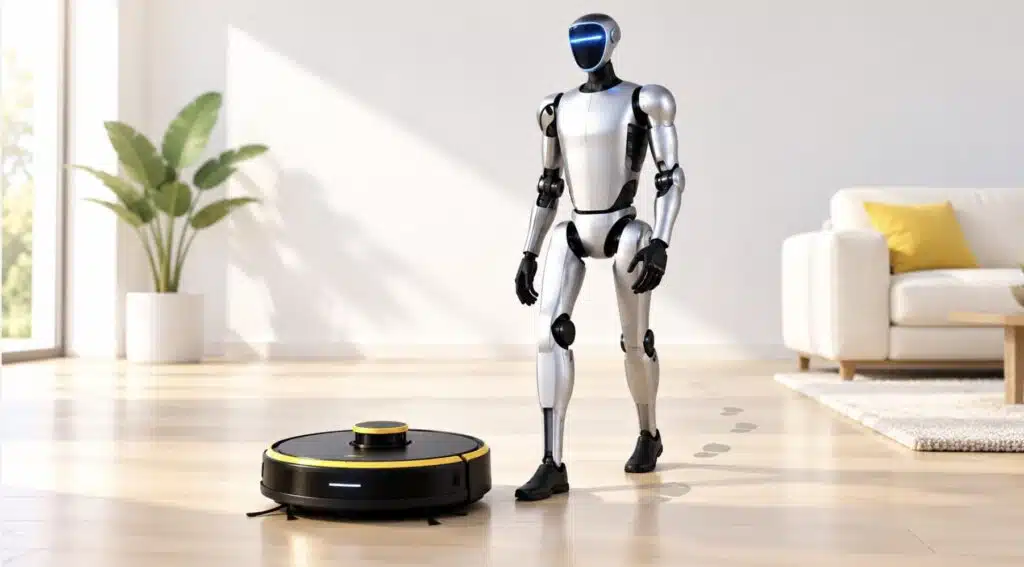
What can a robot vacuum actually do well?
Robot vacuums are genuinely good at one job: keeping open floors from building up dust and pet hair between deeper cleans.
Run on a schedule, a robot vacuum keeps hard floors and low-pile carpet from visibly collecting debris day to day. For a home with pets or kids, that is a real, useful layer of maintenance. It is also the entire job the device can do. It has no arms, no cloth, no cleaning solution, and no way to reach anything that is not open floor.
What can’t AI clean yet?
Walk through what a professional cleaning actually covers: toilets, showers, sinks, countertops, stovetops, the inside and outside of appliances, mirrors, glass, cabinet fronts, baseboards, and detail work in corners and under furniture. None of that is vacuuming, and none of it is close to automated at the consumer level.
What AI cleaning covers today
- Open hard floors
- Low-pile carpet
- Loose debris and dust
- Pet hair on floors
- Runs on a fixed schedule automatically
What it still can’t touch
- Bathrooms and kitchens
- Counters, appliances, mirrors, glass
- Baseboards, corners, edges
- Stairs, in most cases
- Any scrubbing, wiping or disinfecting
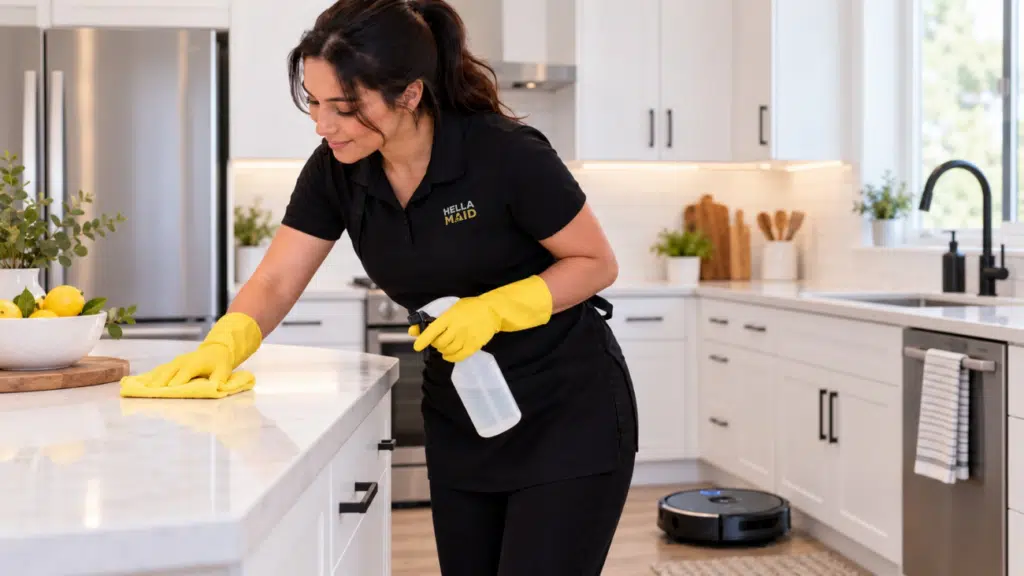
Why cleaning is harder to automate than it looks
Most jobs that resist automation share one trait: they require judgment that changes with context, not a fixed motion repeated the same way every time. Cleaning is a clear example. A cleaner adjusts pressure based on the surface, checks whether a stain came out or needs a second pass, and knows a marble counter and a laminate one need different products. A robot vacuum does the same fixed motion regardless of what it senses on the floor. That gap, between a repeatable motion and a judgment call, is the real reason a bathroom is nowhere close to being automated while a floor is.
What about those viral humanoid robot cleaning videos?
Almost none of them are what they look like. Most are demo reels for expensive research robots, not products you can buy or book to clean your home.
If you have seen a video of a humanoid robot loading a dishwasher or wiping a counter, you have probably seen one of a handful of research platforms from companies like Unitree, Figure, or Tesla’s Optimus program. These are real machines, and the underlying engineering is genuinely impressive. But three things are almost always true about the clips that go viral:
- Many are remote-operated or heavily edited, not running fully on their own. A person off-camera is often guiding part or all of the motion, and the clip shows the one clean take out of many attempts.
- The hardware is priced like industrial equipment, not a home appliance. A general-purpose humanoid robot like this typically costs somewhere in the tens of thousands of dollars, aimed at researchers and developers, not homeowners.
- Nobody can currently walk into a store, or book an app, and get one of these robots to autonomously clean a real, messy, unfamiliar home. The homes in these demos are usually controlled environments the robot has been trained on or tuned for in advance.
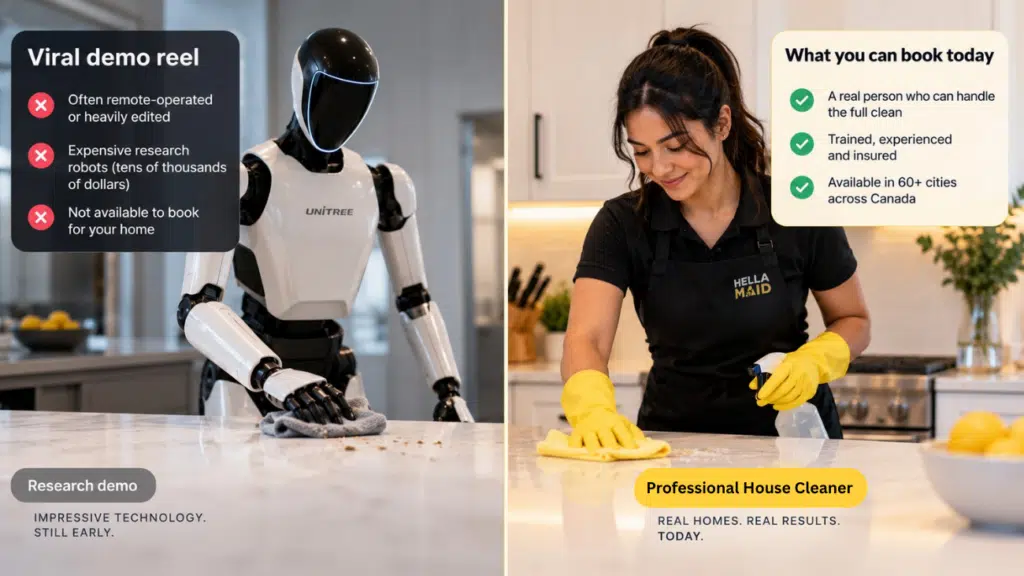
This matters because ads and social posts sometimes blur that line on purpose, offering to “book” a humanoid robot cleaner at an hourly rate as if it were an Uber for house cleaning. Read those claims the same way you would read any surprising ad: if a research-grade humanoid robot were actually available to book by the hour to clean strangers’ homes unsupervised, it would be front-page technology news, not a caption on a video. The honest version of the story is the one above: it is real technology, it is moving fast, and it is not yet a product sitting in anyone’s living room.
How is AI actually used in professional cleaning today?
Behind the scenes, not on the mop. AI already runs the administrative side of a cleaning company: booking, scheduling, and route planning.
This is the part most people never see. On our end, software plans cleaner routes, matches customer bookings to available time slots, and handles a large share of scheduling and rebooking automatically. That is a real, meaningful use of AI in the cleaning industry, and it is happening right now across the sector. It just has nothing to do with the physical act of cleaning a home. The booking gets smarter. The scrubbing still needs a person.
Stairs and multiple floors are a real limit
Almost no consumer robot vacuum can climb stairs. If a home has more than one level, the device is confined to whichever floor you put it on, and covering the rest of the house means buying and maintaining a separate unit per floor. This is one of the most common reasons homes that own a robot vacuum still book a professional service: the device simply cannot reach the rest of the house.
What we actually see in homes that own one
Most customers who own a robot vacuum still keep a recurring cleaning on the schedule. The device changes what that visit needs to cover, not whether they need it.
In practice, a robot vacuum shifts a recurring clean rather than replacing it. Customers on a recurring cleaning schedule who also own a robot vacuum often tell us the floors need less attention at each visit, which frees up time for bathrooms, kitchens, and detail work instead. If you are weighing how often you actually need a professional visit, we break that down separately in how often a house should be professionally cleaned.
For the record
“A robot vacuum has never once cleaned a toilet, wiped a counter, or told us a stain needed a second pass. Until it can, this is still tool that mainly helps with floors, if at all. The robot vacuum will never be a replacement for a professional house cleaner.”
— Ahmed Mezil, CEO at Hellamaid
Is the cleaning industry at risk from automation?
Split the question in two, because the answer is different for each half. The administrative side of running a cleaning business, booking, payments, scheduling, is already substantially automated across the industry and will keep getting more so. The physical side, the actual cleaning, is not, because it depends on the kind of varied, judgment-based physical work that has proven difficult to automate across almost every industry, not just this one. Robot vacuums are the most advanced consumer cleaning automation that exists today, and they still only solve one narrow slice of the job.
Should you buy a robot vacuum, book a cleaning service, or both?
You have pets or kids
A robot vacuum earns its keep fast. Daily floor upkeep between visits is exactly the gap it fills well.
You want the whole home covered
The most common pattern we see: robot for daily floors, a person on a recurring schedule for everything else.
You want it instead of a cleaner
It cannot do most of what a real clean covers. Expect a partially clean home, not a fully clean one.
The honest bottom line
AI has not replaced house cleaners, and the reason is mechanical, not sentimental. Suction on an open floor is one task among dozens, and the rest of a real clean, bathrooms, kitchens, surfaces, judgment about what a room actually needs, requires a person. A robot vacuum is a good tool for the narrow job it does. It was never built to do the rest, and nothing on the market today is close.
Since March 2017, Hellamaid has completed more than 70,000 bookings in Canada, nearly 70% of them recurring. Not one was completed by a robot.
Frequently asked questions
Will AI replace house cleaners?
No, not with the technology available today. AI and robot vacuums can maintain open floors, but a professional clean is mostly bathrooms, kitchens, surfaces, and detail work, none of which current robots can physically do.
Can a robot vacuum fully replace a house cleaner?
No. A robot vacuum only cleans open floor space. It cannot clean bathrooms, kitchens, counters, mirrors, baseboards, or anything above floor level, which is most of what a professional cleaning covers.
What jobs can AI actually take over in home cleaning?
AI is already used behind the scenes in the cleaning industry for things like online booking, scheduling, route planning for cleaners, and customer communication. It is not used for the physical cleaning itself beyond robot vacuums and mops on open floors.
Will AI ever be able to clean a bathroom?
Not with current consumer technology. Cleaning a bathroom requires reaching into corners, scrubbing at different angles, judging how dirty a surface is, and using the right product on the right material, all far harder problems than vacuuming a flat floor.
What’s the difference between a robot vacuum and a house cleaner?
A robot vacuum performs one task, suction on open floors, on a fixed schedule. A house cleaner adjusts to what a room actually needs that day, cleans surfaces above floor level, disinfects, and handles bathrooms and kitchens, none of which a robot vacuum can do.
Do robot vacuums work on stairs or multiple floors?
Most robot vacuums cannot climb stairs and are confined to a single level unless you buy and maintain a separate unit for each floor.
Is the cleaning industry at risk from automation?
The parts of cleaning that are physical, judgment-based, and require reaching varied surfaces are difficult to automate with current robotics. The parts of running a cleaning business that are administrative, like booking and scheduling, are already automated in many companies.
Are the viral humanoid robot cleaning videos real?
The robots are real research platforms, but most viral clips are remote-operated or edited demos, not evidence of a robot you can currently buy or book to autonomously clean a home. The hardware is typically priced for researchers and developers, in the tens of thousands of dollars, not sold as a consumer product.
Is it worth combining a robot vacuum with a cleaning service?
Yes, this is the most common pattern among customers who own one. The robot handles daily floor upkeep and a professional cleaning handles bathrooms, kitchens, surfaces, and the deeper clean on a recurring schedule.
What a cleaning robot still can’t give you
Everything above is a mechanical argument: floors versus bathrooms, motion versus judgment. This last part isn’t mechanical at all.
A robot vacuum doesn’t notice your dog is anxious and needs an extra minute. It doesn’t remember that you just moved and this is your first clean in the new place. It doesn’t leave a home feeling cared for, it leaves it vacuumed. That difference is small on a spec sheet and enormous in a home.
Finally, a robot will never offer something a real person can: care and warmth into your home.

Let the robot handle the floors. We’ll handle the rest.
Book a recurring cleaning for the bathrooms, kitchens, and detail work no device can reach.
Related reading
- How often should a house be professionally cleaned?
- DIY vs professional cleaning
- Do bi-weekly customers actually pay less per year?
- Recurring cleaning services
- Hourly cleaning rates in Ontario
About this post: Hellamaid is a Canadian residential cleaning company serving more than 60 cities. This piece reflects what our team observes in homes we clean, including homes that use robot vacuums alongside a recurring professional service, and how our own company uses scheduling and booking automation.